
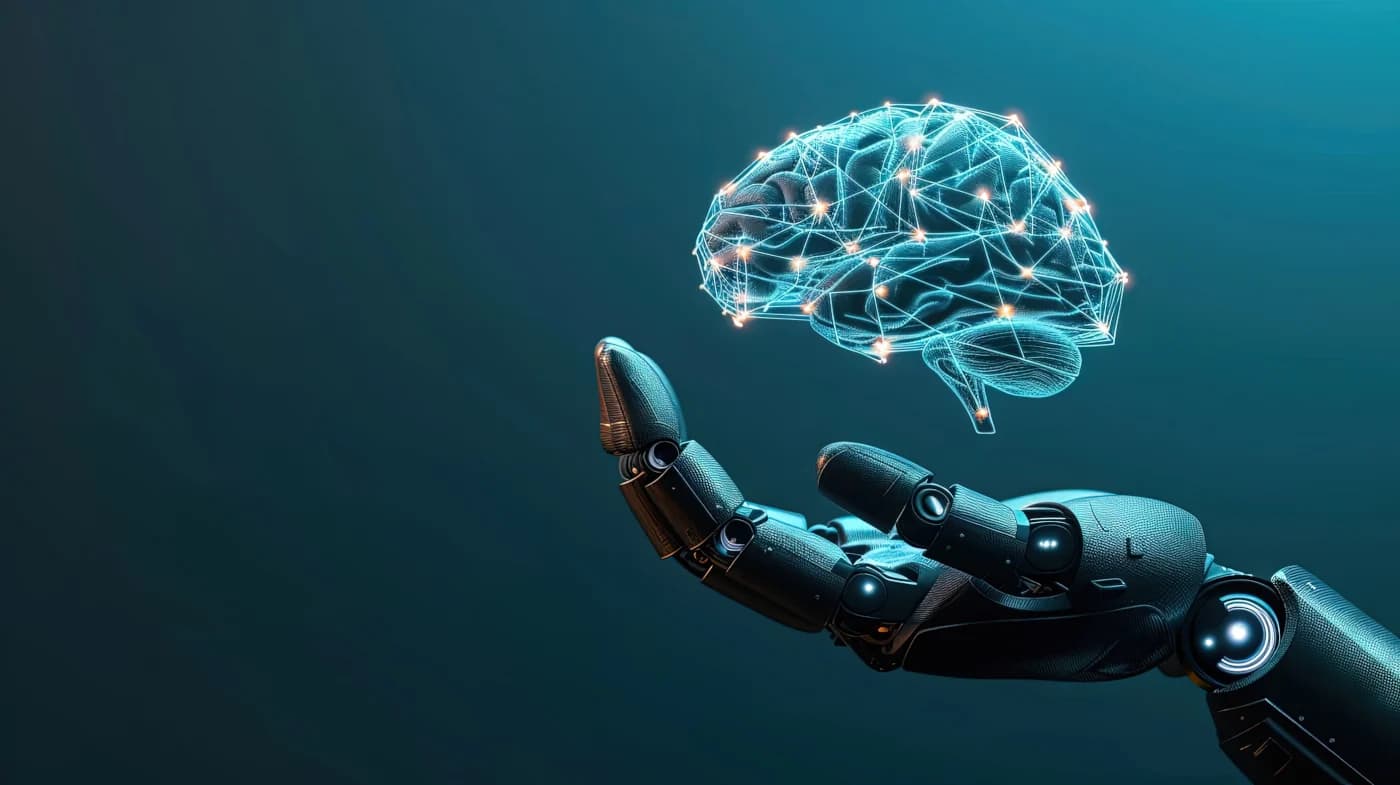
Artificial intelligence is not merely a tool; it is becoming an agent. It can learn, adapt its behavior, and make decisions within the goals we give it.
A knife is a tool. You can use it to cut vegetables, or you can use it to stab someone. You make the decision: will the knife prepare food, or will it be used to commit a crime?
Artificial intelligence is different. It is more like a knife that possesses some ability to make decisions, and that can even help produce and control new kinds of tools.
This is where one of the most concerning aspects of artificial intelligence lies. We are no longer talking only about a more powerful tool. We are talking about a tool to which we can give a goal, then allow it to take over an increasing part of the thinking, planning, and execution required to reach that goal.
One influential theory about how humans came to dominate the planet argues that language was one of the main reasons for our advantage over other creatures. Language allowed humans to transfer knowledge, make plans, cooperate with enormous numbers of people, and build societies and institutions that could not have existed without it.
For a very long time, humans were the only creatures able to produce and use language at this level. But today, after humans were the only ones producing language in this way, another question has appeared: who produces more language now, humans or artificial intelligence?
That question moves the discussion beyond technology and into questions about the future of humanity. Intense global debates are already taking place around the ethics of artificial intelligence, and many employees and workers have begun to sense the danger.
Will artificial intelligence take away our jobs?
If AI can already perform many digital tasks with an efficiency approaching that of humans, and at a speed that makes human work look incredibly slow by comparison, will there still be a need for human employees in the future?
We should move beyond the claim for which there is little evidence and which has become almost a hollow slogan: “AI will not replace you; it will be your intelligent assistant.” This issue deserves a more realistic discussion.
A quick look at documented workforce reductions at major companies such as Oracle, Amazon, and Meta can make people suspicious that AI is involved. Most companies do not identify artificial intelligence as the only cause, and layoffs can result from many different factors. Still, something is changing, including the way companies think about how many employees they need to get the work done.
Perhaps the more dangerous side is new hiring. Some studies have pointed to declining hiring among younger workers in certain occupations more exposed to AI, making junior employees one of the groups that deserves close attention.
The problem is not simply that artificial intelligence is developing. The problem is that it is developing so quickly that adapting to the change is becoming difficult.
Imagine that you are an ordinary programmer using an AI model to help with your work. You are away for two months. When you return, there is a new model from the same company, released only a few months after the one you used.
You try it, and you are surprised. The new model is much more capable, makes far fewer mistakes, works faster, understands your requests more easily, and handles tasks the previous model could not handle.
We are talking about two models from the same company, separated by months rather than years, yet the improvement is enormous. What may be most concerning is not AI itself, but the speed at which it is developing. It is becoming genuinely difficult to predict what the world will look like not fifty years from now, but just five years from now.
Perhaps we should consider Elon Musk’s answer in an interview dated...
> “By 2030, artificial intelligence will be vastly greater than the collective intelligence of humanity, and there will be nothing that AI cannot do better than humans.”
He may be wrong. The prediction may be exaggerated. But the mere possibility of reaching that level of capability makes the question more urgent.
If companies stop hiring juniors, how will there be experts in the future? I am not claiming that this will happen, but it is a hypothesis worth examining.
In the job market, junior workers may be among those most exposed to losing opportunities to enter the workforce, or to being expected to possess skills traditionally associated with senior employees.
The traditional path looks like this: you start as a Junior, gain experience, become Mid-level, gain more experience, and eventually become Senior. That cycle could be disrupted if companies no longer need juniors because AI can perform much of their work more efficiently.
So how will we get Seniors in the future? And will we need Seniors at all? Artificial intelligence has made both questions open to debate.
The speed of this development is almost unbelievable. The first practical steam engines appeared in the early eighteenth century, and it took many decades for engine technology to evolve into new forms. Today, AI models can change dramatically within months.
GPT first appeared as a family of models capable of predicting and generating text, with capabilities that were extremely limited compared with what we see today. Look at what these models can do now. All of this has happened in an extremely short period.
Perhaps this is the real problem: not only what artificial intelligence can do today, but what it may be able to do a few years from now.
Perhaps that is an overly pessimistic view. The bombs and weapons of mass destruction in the world are powerful enough to destroy our planet countless times, yet humanity has so far chosen not to destroy itself. Possessing extraordinary power does not necessarily mean the end of the world.
Just as humans came to understand the importance of using nuclear energy to generate power instead of using it to destroy one another, perhaps we will find a way to use artificial intelligence in the best possible way.
Sam Altman, the CEO of OpenAI, once described the goal this way: “I think this could be the greatest technological product in the history of humanity, but it only becomes valuable if it manages to make people’s lives better.”
The optimistic vision is that every human being will have a genie capable of granting wishes. Perhaps the first thing humanity should ask this genie for is to create things that benefit humanity as a whole.
Sam Altman does not necessarily believe that AI will destroy human work. Instead, he expects there to be a very large number of jobs and believes that humans in the future may be busier than they are today.
And this is where the subject becomes more complicated. Artificial intelligence may really become the greatest tool humanity has ever created, a genie that allows every person to do things they could never do before.
But it may also be the first kind of tool for which we cannot confidently predict what the world will look like once its capabilities exceed ours in an increasing number of areas.
Are we facing a tool that will make humanity more powerful than ever, or the first tool that may force us to redefine what it means for humans to be the most intelligent beings on the planet?